
Can Indian MBBS Graduates Work as Doctors in Vietnam? Licensing Explain
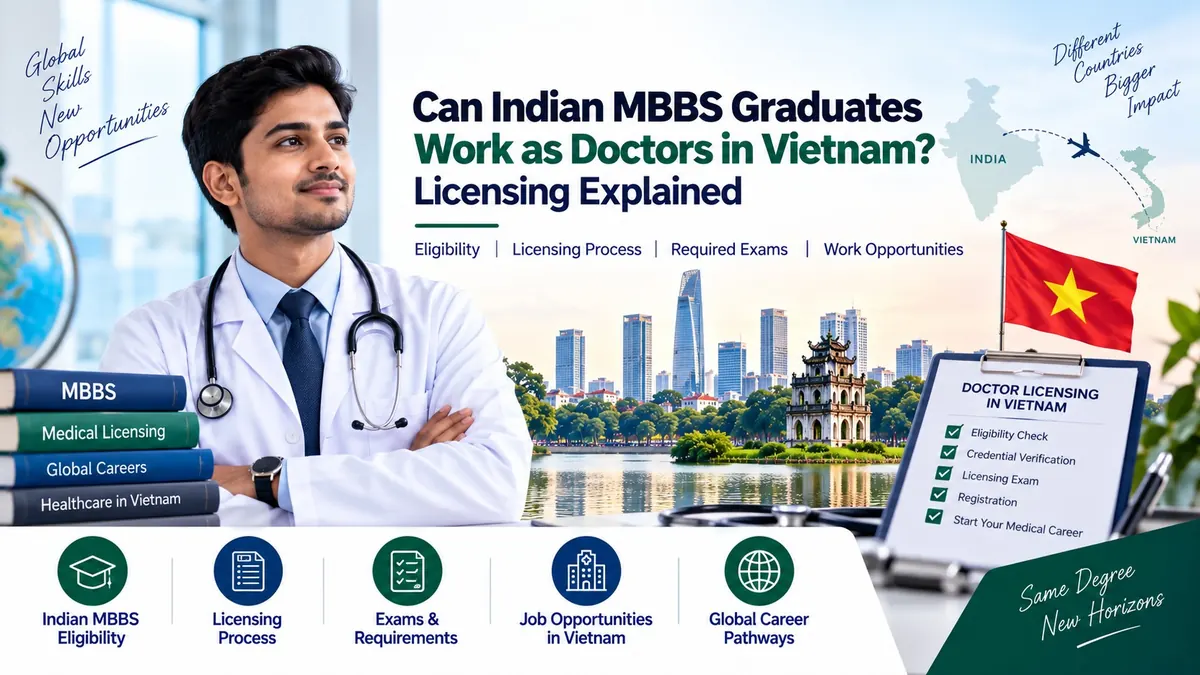
Highlights
- An MBBS degree alone does not automatically authorize independent medical practice in Vietnam.
- Foreign doctors must satisfy Vietnam's applicable professional licensing requirements.
- Vietnamese language requirements can be important for foreign practitioners providing care directly to Vietnamese patients.
- Recognition of an overseas practice licence is subject to specific legal conditions.
- Employment, immigration and professional licensing are separate requirements.
Quick Answer
Yes, an Indian medical graduate may potentially work as a doctor in Vietnam, but an MBBS degree by itself does not automatically give the right to independently practise medicine there.
Vietnam's current Medical Examination and Treatment framework requires individuals practising medicine to have a valid practice licence, register their practice where required and satisfy applicable language and professional conditions. The law also provides specific rules concerning recognition of practice licences issued by foreign authorities.
For an Indian graduate, the actual pathway therefore depends on factors such as the medical qualification, professional experience, licensing status, employer, type of work and the current Vietnamese regulations applicable at the time of application.
Is an Indian MBBS Degree Automatically Enough?
No.
Graduating from a medical university in India—or completing an MBBS in Vietnam as an Indian student—does not by itself mean that a person can immediately open a clinic or work independently as a physician in Vietnam.
Vietnam's current law states that a person practising medical examination and treatment generally needs a valid practice licence, registration of practice where applicable and compliance with language requirements.
This distinction is important:
Medical degree ≠ medical licence ≠ employment authorization
These are separate parts of the process.
What Does Vietnam Require From Foreign Doctors?
Vietnam's Ministry of Health explains that foreign practitioners are subject to specific conditions when applying for professional authorization.
The current framework includes requirements concerning professional qualifications, health, professional competence and language. The Ministry's administrative guidance also identifies documentation and procedures applicable to foreign practitioners.
Depending on the applicant's circumstances, the authorities may need to assess:
- Medical qualification
- Professional competence
- Existing practice licence
- Practical/clinical experience
- Health status
- Language ability
- Professional scope
- Employment arrangements
- Supporting documentation
The exact requirements should be checked against the current Vietnamese procedure before making a career decision.
What About Vietnamese Language?
This is one of the most important considerations for an Indian doctor planning to practise clinically in Vietnam.
Vietnam's Ministry of Health states that foreign practitioners who directly provide medical examination and treatment to Vietnamese patients are subject to Vietnamese-language requirements. Where the practitioner does not have sufficient Vietnamese proficiency, the legal framework provides for registered language use and an interpreter in applicable circumstances.
The Ministry has also explained that the legislation places particular importance on Vietnamese-language capability for foreign practitioners working long-term and treating Vietnamese patients directly.
Therefore, an Indian doctor should not assume that English proficiency alone will be sufficient for unrestricted clinical practice.
Can a Foreign Medical Licence Be Recognized?
Vietnam's current law provides a mechanism for considering recognition of a practice licence issued by a competent foreign authority.
However, recognition is conditional rather than automatic.
The consolidated 2026 version of Vietnam's Medical Examination and Treatment Law states that a foreign practice licence may be considered for recognition when conditions including validity, appropriate professional title and applicable treaty or recognition requirements are satisfied.
This means an Indian doctor should have the relevant professional documents properly verified before assuming that an Indian licence can simply be transferred to Vietnam.
Does a Work Permit Matter?
Yes.
Professional authorization and employment authorization should not be confused.
Vietnam's Ministry of Health administrative information for foreign practitioners identifies employment-related documentation, including a work permit where applicable, alongside professional licensing requirements.
A doctor therefore needs to consider at least two separate questions:
1. Am I legally permitted to practise medicine?
2. Am I legally permitted to work for this employer in Vietnam?
The answers may involve different authorities and procedures.
What Career Options Could Exist?
An Indian MBBS graduate interested in Vietnam does not necessarily have to pursue only traditional clinical practice.
Depending on qualifications and eligibility, potential healthcare-related career directions can include:
- Clinical medicine
- Medical research
- Public health
- Clinical research
- Medical education
- Healthcare administration
- Pharmaceutical or medical-device industries
- Global health programs
- Academic medicine
Clinical practice requires the relevant professional authorization, while non-clinical roles may have different requirements.
Important Difference: Working During Medical School
Medical students can participate in clinical education under supervision as part of an approved training program.
Vietnam's current law specifically recognizes situations involving health-sector students and trainees, allowing them to participate in medical examination and treatment under the supervision of qualified practitioners.
This does not mean that a medical student is licensed to work independently as a doctor.
That distinction is particularly important when evaluating internships, electives and hospital training programs.
A Practical Path for an Indian Graduate
If your long-term goal is to work clinically in Vietnam, consider this sequence:
Step 1: Complete Your Medical Qualification
Finish the required medical education and clinical training.
Step 2: Maintain Your Professional Records
Keep academic transcripts, degree certificates, internship records, registration/licensing documents and experience certificates properly documented.
Step 3: Identify the Exact Job
Requirements may differ depending on whether you want to work in a hospital, clinic, university, research institution or another healthcare organization.
Step 4: Check Vietnamese Licensing Requirements
Verify the current requirements with the Vietnamese health authorities before accepting a clinical position.
Step 5: Address Language Requirements
If the intended role involves direct patient care, determine the applicable Vietnamese-language requirement and interpreter provisions.
Step 6: Confirm Employment Authorization
Check work-permit and immigration requirements separately from medical licensing.
Myths vs Facts
Myth: An Indian MBBS degree automatically allows you to practise medicine in Vietnam.
Fact: A medical degree and authorization to practise are separate matters.
Myth: Speaking English is always enough for clinical practice.
Fact: Vietnam has specific language requirements for foreign practitioners providing care to Vietnamese patients.
Myth: An Indian medical licence automatically transfers to Vietnam.
Fact: Foreign practice licences may be considered for recognition subject to specific legal conditions.
Myth: A student doing hospital training is already licensed as a doctor.
Fact: Students and trainees operate under specific supervised-training provisions and should not be confused with independently licensed practitioners.
FAQs
Can an Indian MBBS graduate become a doctor in Vietnam?
Potentially, yes, subject to Vietnam's professional licensing, recognition, language, employment and other applicable requirements.
Can I open my own clinic in Vietnam after MBBS?
An MBBS degree alone does not automatically authorize you to open and independently operate a medical practice. Appropriate professional authorization and other legal requirements would need to be satisfied.
Is Vietnamese language compulsory for foreign doctors?
Vietnamese-language requirements apply to foreign practitioners directly treating Vietnamese patients, with specific provisions concerning language registration and interpreters in applicable circumstances.
Can an Indian medical licence be recognized in Vietnam?
Vietnam's legal framework provides for recognition of certain foreign practice licences when specified conditions are met. Recognition should be confirmed with the relevant Vietnamese authority for the individual case.
Can MBBS students work in Vietnamese hospitals?
Students can participate in approved supervised medical education and training. This should not be confused with independent medical practice.
Is working as a doctor in Vietnam the same as practising in India?
No. Each country has its own professional licensing and registration system. An Indian graduate must separately satisfy the requirements of the country where they intend to practise.
Key Takeaway
An Indian MBBS graduate can potentially build a medical career in Vietnam, but the degree itself is not a licence to practise independently.
The most important factors are professional qualification, licensing or recognition, clinical competence, Vietnamese-language requirements, employment authorization and the exact scope of the proposed job.
Students considering MBBS in Vietnam should therefore think beyond graduation. If Vietnam is part of your long-term career plan, start understanding the licensing framework, language requirements and potential career routes well before completing your degree.
Planning to Study MBBS in Vietnam for 2026?
Connect with our medical advisory counselors. Get official university fee schedules, step-by-step documentation checklists, and direct university admission assistance.